

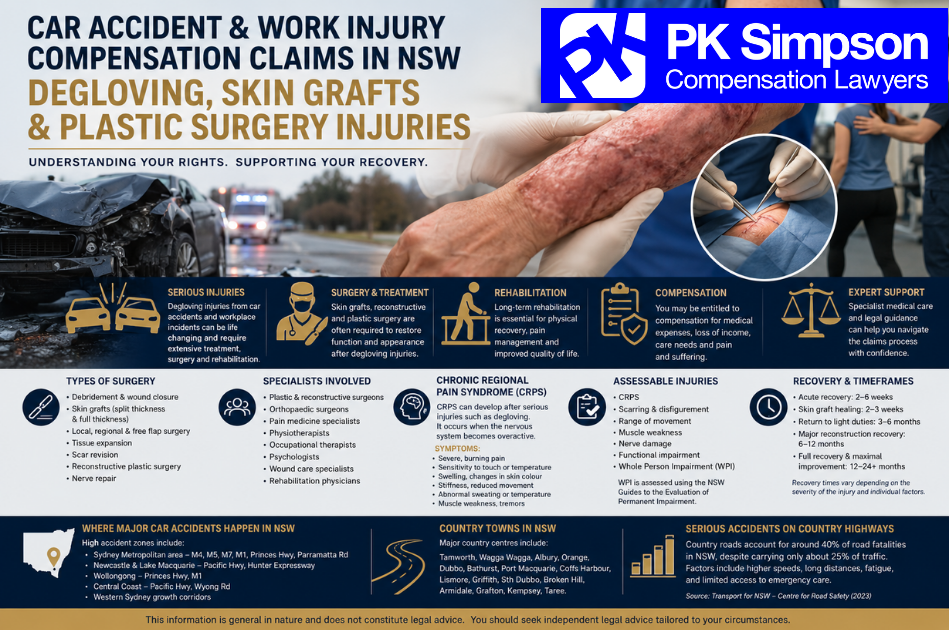
Car Accident and Work Injury Compensation Claims in NSW Involving Degloving Injuries, Skin Grafting and Plastic Surgery
Introduction
Serious motor vehicle accidents and workplace incidents in New South Wales can cause catastrophic injuries that permanently alter a person’s life. Among the most severe traumatic injuries are degloving injuries, extensive soft tissue damage, crush injuries, burns, and injuries requiring skin grafting and reconstructive plastic surgery. These injuries are often associated with industrial accidents, machinery incidents, motorcycle crashes, heavy vehicle collisions, farming accidents, construction site trauma, and high-speed country highway accidents.
In NSW, injured persons may have rights to claim compensation through the workers compensation system, compulsory third party (CTP) insurance schemes, work injury damages claims, public liability claims, and common law damages depending on the circumstances of the incident.
Degloving and skin graft injuries frequently result in prolonged hospitalisation, multiple surgical procedures, chronic pain, permanent scarring, reduced mobility, psychological trauma, and long-term impairment. Recovery can take months or years and often involves a multidisciplinary team of surgeons, rehabilitation specialists, psychologists, physiotherapists, occupational therapists, pain specialists, and vocational rehabilitation providers.
This article explains the nature of degloving injuries, the surgeries commonly required, rehabilitation pathways, recovery timeframes, chronic regional pain syndrome (CRPS), and the assessable injuries that commonly arise in compensation claims in NSW.
What Is a Degloving Injury?
A degloving injury occurs when the skin and underlying tissue are violently torn away from the muscles, fascia, bone, or tendons beneath. The injury resembles the removal of a glove from a hand, which is how the condition obtained its name.
Degloving injuries are considered medical emergencies because they frequently involve:
- Severe blood loss;
- Tissue death (necrosis);
- Infection risk;
- Exposed tendons, muscles, or bone;
- Nerve damage;
- Vascular compromise;
- Permanent functional loss.
These injuries can occur in virtually any part of the body, although they are most common in:
- Legs and lower limbs;
- Feet and ankles;
- Hands and arms;
- Scalp and facial regions;
- Pelvis and torso.
The injuries may be classified as either:
Open Degloving Injuries
Open degloving injuries involve obvious tearing away of the skin from underlying tissue. These are often visually severe and require urgent surgical intervention.
Closed Degloving Injuries
Closed degloving injuries occur where the skin remains intact but is separated from underlying tissue, creating a pocket of blood, fluid, and damaged tissue beneath the skin. These are sometimes referred to as Morel-Lavallée lesions.
Common Causes of Degloving Injuries in NSW
Degloving injuries frequently arise in high-energy trauma events. In NSW, the most common causes include:
Motor Vehicle Accidents
High-speed collisions involving cars, trucks, motorcycles, and pedestrians commonly produce crushing and shearing forces capable of causing degloving injuries.
Motorcyclists are particularly vulnerable because they lack the structural protection of a vehicle. Riders who slide along bitumen after impact frequently sustain severe skin loss and soft tissue trauma.
Workplace Accidents
Workplace degloving injuries often occur in industries involving machinery and heavy equipment.
Common examples include:
- Conveyor belt incidents;
- Forklift accidents;
- Agricultural machinery accidents;
- Roller or press machinery;
- Construction site crush injuries;
- Industrial entrapment incidents;
- Mining and manufacturing accidents.
Workers may become trapped in moving machinery, resulting in traumatic tearing injuries to the hands, arms, legs, or scalp.
Farming and Rural Accidents
Rural NSW experiences a significant number of severe agricultural injuries involving tractors, augers, harvesters, livestock handling equipment, and quad bikes.
Country workers often face delayed access to major trauma centres due to geographic isolation, increasing the severity of complications.
Major Car Accident Areas in NSW
Serious motor vehicle accidents occur throughout NSW, however several roads and regional areas are historically associated with elevated rates of catastrophic trauma.
Sydney Metropolitan Areas
Major accident locations within metropolitan Sydney include:
- The M4 Motorway;
- The M5 Motorway;
- The M7 Motorway;
- Parramatta Road;
- The Princes Highway;
- The Hume Motorway;
- The Pacific Motorway.
Heavy traffic congestion, high-speed merging, fatigue, distracted driving, and commercial transport movement contribute to major collisions.
Regional and Country NSW Highways
Many of the most serious and fatal accidents occur on country highways due to higher speed limits, driver fatigue, wildlife hazards, overtaking collisions, and long emergency response times.
Country highways with significant serious injury rates include:
- The Pacific Highway;
- The New England Highway;
- The Hume Highway;
- The Great Western Highway;
- The Mitchell Highway;
- The Oxley Highway;
- The Newell Highway;
- The Princes Highway;
- The Sturt Highway.
Regional NSW towns commonly associated with serious road trauma include:
- Dubbo;
- Wagga Wagga;
- Tamworth;
- Orange;
- Bathurst;
- Goulburn;
- Coffs Harbour;
- Lismore;
- Albury;
- Broken Hill;
- Griffith;
- Armidale;
- Moree;
- Taree;
- Kempsey.
Every year, hundreds of people suffer serious injuries on country roads in NSW. Regional roads account for a disproportionate percentage of fatalities and catastrophic injuries despite lower population density. Head-on collisions, rollovers, truck accidents, and motorcycle crashes are particularly common in rural areas.
Emergency Treatment Following a Degloving Injury
Patients with severe degloving injuries are often transported to major trauma hospitals such as:
- Royal North Shore Hospital;
- Westmead Hospital;
- St George Hospital;
- John Hunter Hospital;
- Liverpool Hospital.
Initial emergency treatment focuses on:
- Controlling bleeding;
- Preventing shock;
- Restoring circulation;
- Stabilising fractures;
- Cleaning contaminated wounds;
- Preventing infection;
- Preserving viable tissue.
Patients may undergo emergency surgery within hours of the injury.
Plastic Surgery and Reconstructive Procedures
Degloving injuries frequently require extensive plastic and reconstructive surgery. Many patients undergo multiple operations over several months or years.
Debridement Surgery
Debridement involves the surgical removal of dead, contaminated, or infected tissue.
This procedure is critical because necrotic tissue can rapidly cause severe infection or sepsis.
Patients may require repeated debridement surgeries before reconstruction can commence.
Skin Grafting
Skin grafting is one of the most common procedures following severe soft tissue trauma.
A skin graft involves removing healthy skin from one area of the body and transplanting it onto the injured area.
Split Thickness Skin Grafts
Split thickness grafts involve taking the epidermis and part of the dermis.
These grafts are commonly used for:
- Large wound coverage;
- Burn injuries;
- Extensive skin loss.
Although effective, they may result in:
- Texture differences;
- Pigmentation abnormalities;
- Fragility;
- Contracture formation.
Full Thickness Skin Grafts
Full thickness grafts involve removal of the entire dermis and epidermis.
These grafts are often used in cosmetically sensitive areas such as:
- The face;
- Hands;
- Neck.
They generally provide superior cosmetic outcomes but require adequate blood supply to survive.
Flap Reconstruction Surgery
In severe injuries where bone, tendons, or nerves are exposed, flap reconstruction may be required.
A flap procedure transfers skin, fat, muscle, and blood vessels from another part of the body.
Types of flap surgeries include:
- Local flaps;
- Regional flaps;
- Free tissue transfer;
- Muscle flaps;
- Fasciocutaneous flaps.
Microsurgery is often required to reconnect blood vessels.
Orthopaedic Surgery
Many degloving injuries occur alongside fractures and crush injuries.
Orthopaedic surgeons may perform:
- Internal fixation;
- External fixation;
- Joint reconstruction;
- Tendon repair;
- Ligament repair;
- Amputation procedures.
Nerve Repair Surgery
Peripheral nerves may be stretched, torn, or crushed during traumatic incidents.
Nerve repair procedures may include:
- Direct nerve repair;
- Nerve grafting;
- Nerve transfer procedures.
Nerve recovery is often slow and incomplete.
Scar Revision Surgery
Many patients later undergo scar revision procedures to improve:
- Function;
- Appearance;
- Contractures;
- Tightness;
- Pain.
Laser treatment, fat grafting, steroid injections, and further plastic surgery may also be required.
Rehabilitation Following Degloving and Skin Graft Injuries
Rehabilitation is frequently prolonged and intensive.
The rehabilitation process aims to restore:
- Mobility;
- Strength;
- Function;
- Psychological wellbeing;
- Independence;
- Return-to-work capacity.
Physiotherapy
Physiotherapists assist patients with:
- Range of movement exercises;
- Muscle strengthening;
- Gait retraining;
- Scar mobilisation;
- Pain reduction;
- Hydrotherapy.
Without rehabilitation, scar tissue can cause significant joint stiffness and contractures.
Occupational Therapy
Occupational therapists assist injured persons to regain functional independence.
This may include:
- Hand therapy;
- Fine motor rehabilitation;
- Activities of daily living retraining;
- Home modifications;
- Return-to-work planning.
Psychological Treatment
Severe trauma often causes substantial psychological injury.
Patients may develop:
- Depression;
- Anxiety;
- Post-traumatic stress disorder (PTSD);
- Body image disturbance;
- Social withdrawal.
Psychologists and psychiatrists frequently play a critical role in recovery.
Pain Management Programs
Chronic pain is common following degloving injuries.
Pain specialists may recommend:
- Medication management;
- Nerve blocks;
- Neuromodulation;
- Ketamine therapy;
- Cognitive behavioural therapy;
- Multidisciplinary pain programs.
Compression Garments and Scar Therapy
Compression garments are commonly used following skin grafting and burns.
These garments help reduce:
- Scar thickening;
- Swelling;
- Hypertrophic scar formation.
Silicone therapy and massage are also commonly utilised.
Recovery Timeframes
Recovery from severe degloving injuries varies significantly depending on:
- The size and depth of tissue loss;
- Infection complications;
- Fractures;
- Nerve involvement;
- Psychological injury;
- Patient age;
- Smoking status;
- Pre-existing health conditions.
Minor injuries may stabilise within several months.
However, severe injuries often involve:
- 6 to 12 months of active rehabilitation;
- Multiple surgeries over several years;
- Permanent functional impairment;
- Long-term pain symptoms.
Some patients never fully recover their prior physical function.
Patients with severe lower limb trauma may require walking aids, braces, orthotics, or permanent vocational restrictions.
Specialists Commonly Involved in Treatment
Degloving and reconstructive injury claims typically involve numerous medical specialists.
Plastic and Reconstructive Surgeons
These surgeons manage:
- Skin grafting;
- Flap reconstruction;
- Scar revision;
- Soft tissue repair.
Orthopaedic Surgeons
Orthopaedic specialists manage:
- Fractures;
- Joint injuries;
- Tendon injuries;
- Crush injuries.
Pain Specialists
Pain medicine physicians assist with chronic pain syndromes and neuropathic pain.
Rehabilitation Physicians
Rehabilitation specialists coordinate long-term recovery programs.
Neurologists
Neurologists may assess nerve injury, neuropathic pain, and CRPS.
Psychiatrists and Psychologists
Mental health practitioners treat trauma-related psychological injury.
Occupational Therapists and Physiotherapists
These practitioners assist with functional restoration and return to work.
Dermatologists
Dermatologists may assist with scar treatment and skin complications.
Chronic Regional Pain Syndrome (CRPS)
What Is CRPS?
Chronic Regional Pain Syndrome (CRPS) is a debilitating chronic pain condition that may develop after trauma, surgery, fractures, crush injuries, or nerve damage.
CRPS is commonly seen following:
- Degloving injuries;
- Orthopaedic trauma;
- Limb surgery;
- Crush injuries;
- Hand injuries.
The condition involves abnormal pain processing within the nervous system.
Pain experienced by the patient is often disproportionate to the original injury.
How Does CRPS Develop?
Although the precise mechanism is not fully understood, CRPS is believed to involve:
- Nerve dysfunction;
- Central nervous system sensitisation;
- Inflammatory responses;
- Abnormal sympathetic nervous system activity.
After trauma, the nervous system may become hypersensitive, causing ordinary stimuli to produce severe pain.
Symptoms of CRPS
Symptoms may include:
- Severe burning pain;
- Extreme sensitivity to touch;
- Swelling;
- Skin colour changes;
- Temperature changes;
- Sweating abnormalities;
- Reduced movement;
- Muscle weakness;
- Tremors;
- Nail and hair changes;
- Stiffness;
- Allodynia;
- Hyperalgesia.
Many patients describe CRPS pain as relentless and life-altering.
Treatment for CRPS
Treatment often requires a multidisciplinary approach involving:
- Pain specialists;
- Physiotherapists;
- Psychologists;
- Rehabilitation physicians;
- Neurologists.
Treatments may include:
- Desensitisation therapy;
- Medication;
- Mirror therapy;
- Graded motor imagery;
- Nerve blocks;
- Spinal cord stimulation;
- Pain management programs.
Early diagnosis is considered important because prolonged CRPS can become increasingly difficult to treat.
Compensation Claims in NSW
Individuals suffering degloving injuries may have entitlements under several compensation systems.
Workers Compensation Claims
Workers injured in the course of employment may claim:
- Weekly wage payments;
- Medical expenses;
- Rehabilitation expenses;
- Permanent impairment compensation;
- Domestic assistance;
- Lump sum compensation.
Workers with significant whole person impairment may also pursue work injury damages claims if negligence can be established.
CTP Motor Accident Claims
Persons injured in NSW motor vehicle accidents may claim compensation through the NSW CTP scheme.
Potential entitlements may include:
- Income support;
- Treatment expenses;
- Care assistance;
- Lump sum damages;
- Pain and suffering compensation;
- Economic loss claims.
Serious injuries involving permanent impairment frequently result in substantial compensation claims.
Public Liability Claims
Where injuries arise from unsafe premises or negligent conduct, public liability claims may also be available.
Examples include:
- Unsafe worksites;
- Inadequate safety systems;
- Defective equipment;
- Negligent road maintenance.
Assessable Injuries in Compensation Claims
Compensation claims involving degloving injuries commonly require assessment of permanent impairment.
In NSW, assessments are often conducted using the American Medical Association Guides and relevant statutory guidelines.
Scarring
Scarring can constitute a significant component of impairment.
Assessments may consider:
- Cosmetic disfigurement;
- Visibility of scars;
- Scar texture;
- Contracture formation;
- Psychological impact.
Facial scarring and highly visible scarring often attract substantial assessment consideration.
Range of Movement Restriction
Joint stiffness and loss of mobility are common following skin grafting and trauma.
Assessors may examine:
- Flexion;
- Extension;
- Rotation;
- Grip strength;
- Dexterity;
- Functional capacity.
Restricted range of movement can significantly affect employability and daily functioning.
Neurological Impairment
Nerve injuries may cause:
- Sensory loss;
- Weakness;
- Neuropathic pain;
- Motor deficits.
These impairments are frequently assessed separately.
CRPS Assessment
CRPS can result in substantial permanent impairment ratings.
The condition may affect:
- Functional use of limbs;
- Pain tolerance;
- Mobility;
- Sleep;
- Psychological health;
- Capacity for employment.
Whole Person Impairment (WPI)
Whole Person Impairment (WPI) is a percentage-based assessment used to quantify permanent impairment.
WPI assessments may incorporate:
- Scarring;
- Orthopaedic injury;
- Neurological deficits;
- Psychological injury;
- Pain syndromes.
Higher WPI ratings may increase entitlement to:
- Lump sum compensation;
- Work injury damages claims;
- Pain and suffering damages.
Psychological Impact of Catastrophic Injuries
The emotional consequences of severe trauma are often profound.
Patients may experience:
- Fear;
- Loss of identity;
- Financial stress;
- Chronic pain fatigue;
- Relationship difficulties;
- Social isolation.
Individuals with visible scarring frequently report reduced confidence and altered self-esteem.
Psychological treatment is often an essential component of long-term recovery.
Long-Term Consequences
Even after surgical healing, many patients continue to experience:
- Chronic pain;
- Reduced endurance;
- Ongoing swelling;
- Altered sensation;
- Temperature sensitivity;
- Scar tightness;
- Functional restrictions.
Some individuals are unable to return to their pre-injury occupation.
Manual labourers, tradespersons, farmers, transport workers, and construction workers may face permanent work restrictions due to reduced strength and mobility.
Importance of Early Legal and Medical Support
Early legal advice and specialist medical management are often critical following catastrophic injury.
Prompt treatment may improve:
- Surgical outcomes;
- Functional recovery;
- Pain management;
- Rehabilitation success.
Legal representation may also assist injured persons to:
- Access treatment;
- Obtain income support;
- Secure rehabilitation services;
- Pursue lump sum compensation;
- Protect future entitlements.
Complex claims involving degloving injuries frequently require expert evidence from multiple specialists. Call PK Simpson Compensation Lawyers on 02 9299 1424 to get prompt and practical support.
Conclusion
Degloving injuries and severe soft tissue trauma represent some of the most devastating injuries seen in NSW motor vehicle and workplace accidents. These injuries commonly involve extensive reconstructive surgery, skin grafting, prolonged rehabilitation, chronic pain, scarring, psychological trauma, and permanent impairment.
Patients often require multidisciplinary care involving plastic surgeons, orthopaedic surgeons, rehabilitation physicians, pain specialists, psychologists, physiotherapists, and occupational therapists.
Compensation claims arising from these injuries may involve substantial issues relating to whole person impairment, scarring, CRPS, loss of function, future treatment needs, economic loss, and long-term care requirements.
With appropriate medical treatment, rehabilitation, and legal support, injured individuals may maximise both their recovery outcomes and their compensation entitlements following catastrophic injury in NSW.